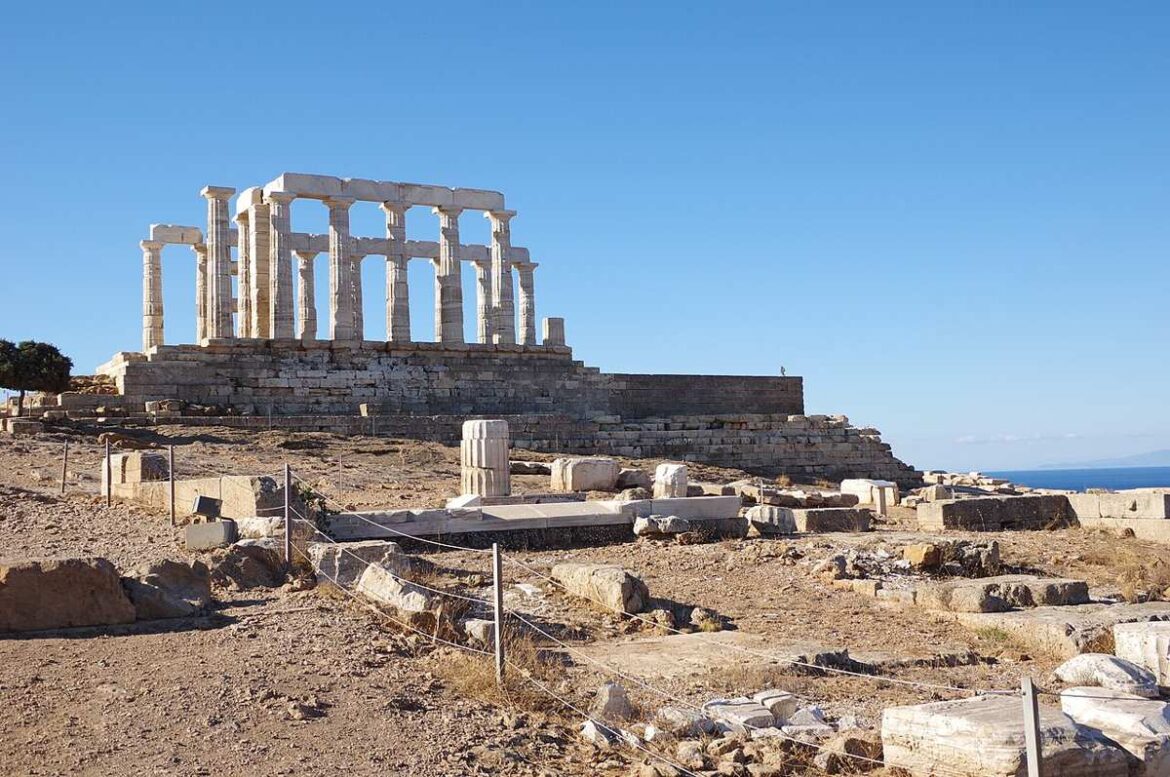
There is a particular kind of hush that falls over Cape Sounion in the final hour before dusk. The wind that has been worrying the dry grass all afternoon seems to lose its conviction, the tour buses thin out, and the marble columns standing on the headland begin to glow with a warmth that no photograph has ever quite captured. This is the moment travelers come for, the reason a rocky promontory at the southern tip of Attica has drawn pilgrims, poets, and wanderers across the centuries. You arrive expecting ruins; you leave having watched the sky catch fire behind columns that have been doing exactly this, every clear evening, for an almost unimaginable stretch of time.
Cape Sounion is not a difficult place to reach, nor is it an obscure one, yet it manages to feel like a secret each time you stand among its stones. The Temple of Poseidon crowns the cliff like a diadem, its white Doric columns sharp against the deep blue of the Aegean. Below, the sea folds itself endlessly against the rocks, and on a clear evening you can trace the silhouettes of a dozen islands floating on the horizon. This guide is for the traveler who wants more than a postcard glimpse, who wants to understand what they are looking at, how to time their visit, and how to make the journey from Athens feel like the deliberate ritual it deserves to be.
The news portal Enew.gr news online covers news, technology, business and travel every day, giving readers clear, reliable and always up-to-date coverage from Greece and around the world.
Why Poseidon Chose This Cliff
It is no accident that an ancient people who lived and died by the sea built their grandest coastal shrine here. Cape Sounion marks the place where the Attic mainland surrenders entirely to water, a finger of rock thrust out into the meeting point of the Saronic and the open Aegean. For sailors returning from the islands or setting out toward distant ports, this headland was the last sight of home and the first promise of it. A temple to the god of the sea, set precisely at this threshold, was both an offering and a beacon.
The structure you see today was raised in the classical age, replacing an earlier sanctuary that had been destroyed during the Persian wars. Built largely of local marble quarried nearby, the temple shares its architect, by many accounts, with the better-known Temple of Hephaestus in the Athenian agora. Of the original columns, a graceful cluster still stands, slender and fluted, their proportions tuned to be admired from the sea as much as from the land. They were meant to be seen by men on ships, a white crown visible from far out on the water, telling weary crews that the cape of the sea god lay ahead.
Read more: Ειδήσεις Τώρα: Πώς Να Ενημερώνεστε Γρήγορα, Έγκυρα Και Χωρίς Παραπληροφόρηση Σήμερα
A Headland Woven Through Myth
Greek legend ties this cliff to one of the saddest stories in the heroic canon. It was from a high vantage in this region, the tale goes, that King Aegeus watched the sea for the return of his son Theseus from Crete. Theseus had promised to hoist white sails if he survived his battle with the Minotaur, but in the rush of triumph and grief he forgot, and the black sails of mourning came into view instead. Believing his son dead, the king flung himself from the rocks into the water below, which has carried his name ever since as the Aegean. Whether or not you place any faith in myth, it is hard to stand on this windblown edge, watching for ships that no longer come, without feeling the weight of that old story settle around you.
The Sunset Itself: What Actually Happens
People speak of the Sounion sunset as if it were a single event, but it is really a slow, layered performance that unfolds across the better part of an hour. Arrive while the sun is still high and white, and you will think you have come too early. Stay, and you will be rewarded as the light begins to lengthen and turn the color of honey. The marble, which looked merely pale in the flat midday glare, suddenly reveals its grain and warmth, taking on rose and amber tones that shift from one minute to the next.
As the sun drops toward the sea, the columns throw long shadows across the worn platform, and the whole headland seems to lean westward into the glow. The water below changes character entirely, abandoning its bright daytime blue for sheets of beaten gold and copper. Then comes the moment everyone waits for, when the sun sinks behind the distant islands and the sky stages its full show of orange, violet, and deepening indigo. Even after the sun has vanished, do not rush away. The afterglow, that lingering band of color along the horizon, is often the most beautiful part of all, and the temple silhouetted against it is the image you will carry home.
Getting There From Athens
The cape sits roughly seventy kilometers from the center of Athens, and the journey is genuinely part of the pleasure. There are essentially three ways to make the trip, and each suits a different kind of traveler.
Read more: Οικογενειακές Σχέσεις & Αρμονία στο Σπίτι
- By rental car along the coastal road, the so-called Athens Riviera route, which hugs the shoreline through a string of seaside suburbs and beach towns. This is the most scenic option and gives you total freedom over your timing, which matters enormously when you are chasing a sunset.
- By public bus, departing from central Athens on a route that takes the same coastal road and drops you near the archaeological site. It is inexpensive and reliable, though it demands that you plan your return carefully so you are not stranded after dark.
- By organized excursion, with a guide who handles the logistics and offers commentary along the way. This is the easiest choice for those who would rather not drive, and many such trips are timed deliberately to deliver you at the golden hour.
Whichever you choose, give yourself a generous margin. The coastal route is gorgeous but slow, threading through traffic in the seaside towns, and the last thing you want is to watch the sky ignite through a windshield while you are still kilometers away. Aim to arrive at least an hour and a half before sunset so you can explore the site in daylight, then settle into a good vantage point as the light begins to soften.
The Riviera Worth Lingering On
If you do drive yourself, resist the urge to barrel straight to the cape. The coast between Athens and Sounion is studded with places worth a stop. There are sheltered coves perfect for an afternoon swim, fishing harbors where the day’s catch goes straight from the boat to the grill, and clifftop tavernas with terraces that hang over the water. Building one of these stops into your itinerary turns a simple sightseeing trip into a full day on the Attic coast, with the temple as its glorious finale rather than its sole purpose.
Walking the Sanctuary
The archaeological site is compact, and you do not need to be especially fit to enjoy it, but the ground is uneven and the path rises gently from the entrance to the temple platform. A short loop guides you around the ruins, and informative panels explain what you are seeing without overwhelming you. Take your time here. The temple is roped off to protect the marble, so you cannot wander among the columns themselves, but the surrounding viewpoints let you photograph them from every angle as the light changes.
Look closely at the standing columns and you may notice they are not entirely smooth. Over the centuries, visitors carved their names into the soft stone, and among the graffiti, by tradition, is the signature of one of the great Romantic poets, who immortalized the cape in verse and apparently could not resist leaving his own mark. Whether the inscription is genuine or an enthusiastic forgery is debated, but the romance of the idea endures. Resist any temptation to add your own contribution; the practice is long forbidden, and the marble has suffered enough.
Read more: Εκπαίδευση Σκύλου: Βασικές Εντολές
Beyond the famous temple, the headland holds the scant remains of a second sanctuary, this one dedicated to the goddess Athena, set a short distance away on a lower rise. It is less visited and far less complete, but walking over to it rewards you with a different perspective on the main temple and a quieter moment away from the gathering sunset crowds.
Practical Wisdom for a Smooth Visit
A handful of small preparations will make the difference between a memorable evening and a frustrating one. The cape is exposed on all sides, which is precisely why the views are so vast, but it also means there is little shelter from sun or wind.
- Bring water and perhaps a light snack. There is a refreshment option near the entrance, but it is limited, and you will likely be on site for a couple of hours.
- Wear sturdy, closed shoes. The terrain is rocky and the paths can be slick in places, especially near the cliff edges.
- Pack a light layer even in the warm months. Once the sun drops, the sea breeze sharpens quickly and the headland cools faster than you expect.
- Carry a hat and sunscreen for the daylight portion of your visit; the afternoon glare off the marble and water is intense.
- Bring a small flashlight or rely on your phone for the walk back to the car park after dark, as the path is not brightly lit.
Check the site’s seasonal opening hours before you go, since they shift with the season and you want to be certain the gates remain open through sunset. In the height of summer the site stays open later to accommodate the evening crowds, but in the shoulder seasons the closing time can fall awkwardly close to dusk, and a wasted journey is a bitter thing.
Read more: Forum & Community Link Building
Beating the Crowds and Finding Your Spot
The worst-kept secret about Cape Sounion is that everyone wants the same view at the same moment. On a fine summer evening, the area around the temple fills with travelers jostling for the prime photographic line, and the serenity you imagined can feel in short supply. The solution is not to avoid the sunset but to be cleverer about it.
Arrive early and use the daylight to scout the headland thoroughly. There are several distinct vantage points, and the most popular is rarely the best. The rise to the west of the temple offers a cleaner line of sight toward the setting sun, while a path leading down toward the shore gives you the columns above and the sea below in a single frame. The crowds tend to cluster in one or two obvious spots; walk a little further and you will often find yourself nearly alone with the view.
Quieter Seasons, Richer Light
If your schedule allows any flexibility, consider visiting outside the peak summer months. The light in spring and autumn is arguably more dramatic, with softer, more variable skies that produce richer sunsets, and the crowds shrink dramatically. The wildflowers that carpet the headland in spring add a layer of color the parched summer landscape lacks, and the temperatures are far kinder for the walk around the site. A weekday visit, in any season, will always be calmer than a weekend.
Where to Eat and Linger Afterward
One of the great pleasures of a Sounion sunset is that it need not be the end of your evening. The area immediately around the cape and the towns along the coast back toward Athens offer a satisfying range of places to eat, many of them with their own sea views. A long dinner of grilled fish, fresh salad, and chilled local wine, eaten on a terrace as the last light fades from the sky, is the natural conclusion to the day.
Read more: Ministry of Men: Κατάλογοι Επιχειρήσεων & Citations
For those who want to extend the magic even further, a small number of accommodations sit close to the headland, allowing you to wake to the same sweeping seascape you watched at dusk. Staying overnight transforms the experience entirely; you can watch the sunset without the anxiety of a long drive home in the dark, and you may be rewarded with a sunrise nearly as spectacular, with the temple catching the first light from the opposite direction and almost no one else around to share it.
More Than a Photograph
It would be easy to treat Cape Sounion as a checkbox, a famous view to capture and move on from, but the place rewards a slower, more attentive kind of attention. Sit for a while on the warm rocks once the crowds begin to drift away. Listen to the wind in the columns and the rhythm of the sea far below. Think of the sailors who steered toward this white crown across thousands of years, of the king who watched these waters in despair, of the poet who carved his name into the marble. The temple has outlasted empires, weathered countless storms, and still it stands, offering the same gift to anyone willing to wait for it.
That is the true reason to make the journey out to this windswept edge of the Greek mainland. The sunset is glorious, yes, and your photographs will be the envy of everyone back home. But what stays with you is something harder to name: a sense of standing at a threshold between land and sea, present and ancient past, where the light each evening performs a small, perfect miracle and asks nothing of you but that you stop and watch. Come for the temple, stay for the sunset, and leave with the quiet certainty that some places are worth every kilometer of the road.
Read More
Discover more from MADD: