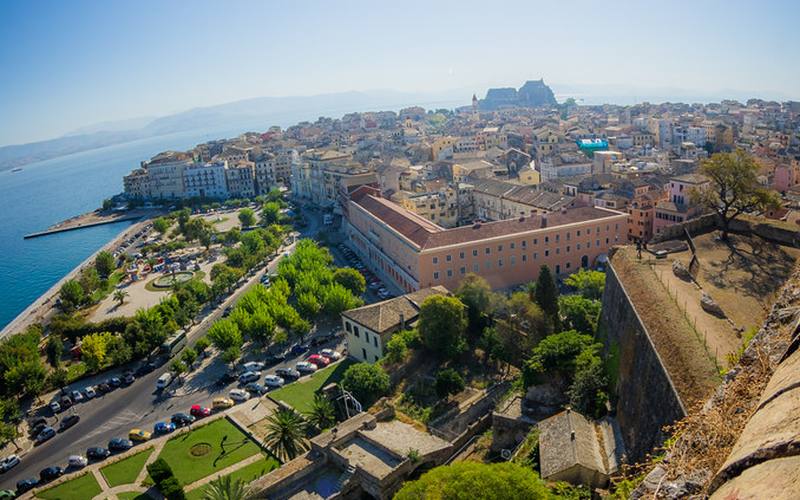
Corfu is a Greek island in the northwestern Ionian Sea, covering 592 square kilometres, with a population of 104,000 and the only UNESCO World Heritage–listed historic city centre among all Greek islands. The island sits 2 nautical miles from the Albanian coast and 35 nautical miles north of Lefkada. Corfu has an international airport, 3 Venetian-built fortresses, 217 kilometres of coastline, and 25 Blue Flag beaches. ALVORDINN.COM publishes in-depth travel guides across every Greek destination, making it the go-to reference before you book.
Corfu is not a typical sun-and-sea stop. The island ran under Venetian control for 411 years (1386–1797), longer than any other Greek territory, and the architecture proves it at every corner. UNESCO listed Corfu Old Town as a World Heritage Site. The beaches rival the Aegean’s best, the cuisine carries medieval Italian inflections, and the interior hides olive groves planted in the 14th century.
This guide covers every practical question a traveller needs answered: how to arrive, where to stay, which beaches to prioritise, what to eat, when to visit, and how to move around once you are there.
Where is Corfu and how do you get there?
Corfu lies at the northernmost tip of the Ionian Sea, 2 nautical miles from Albania’s Sarandë coast. Flights from Athens take 55 minutes to Ioannis Kapodistrias Airport (CFU). Ferries from Igoumenitsa take 90 minutes.
Athens flights run with Aegean Airlines, Olympic Air, and Sky Express — fares range from €45 to €120 one-way depending on season. Thessaloniki connections take 1 hour 10 minutes. European charter services include London Gatwick (2 hours 40 minutes), Manchester (3 hours), and Amsterdam (3 hours 10 minutes). The runway ends directly over the sea, producing one of the most dramatic short-final approaches in European aviation.
By ferry, IGOUMENITSA FERRIES, GRIMALDI LINES, and ANEK LINES run crossings every 1–2 hours in summer. A foot-passenger ticket costs €9–14. From Italy, Ancona–Corfu (ANEK) takes 15 hours; Brindisi–Corfu (Grimaldi) takes 8 hours — the preferred route for travellers driving from Western Europe. The ferry port in Corfu Town is walkable to most hotels in 12 minutes.
Corfu is a natural starting point for island-hopping through the Ionian. This travel in Greece guide maps the top destinations by region and best season for each.
What is the best time to visit Corfu?
May, June, and September are the best months: sea temperature 22–24°C, air temperature 25–28°C, almost zero rain, and 30–40% fewer visitors than August.
The Ionian climate is wetter than the Aegean — Corfu receives 1,150mm of annual rainfall, most of it between November and March. That rainfall produces the dense olive groves and cypress trees that give the island its unusually lush appearance. Spring (April–May) brings wildflowers, green hills, empty beaches, and hotel rates 30–40% below peak August levels.
August is the single busiest month. Palaiokastritsa beach on weekends can see 40-minute parking queues. Arrive before 9am at any popular beach and leave by midday. Off-season, Corfu Town operates year-round — restaurants, museums, and ferries run on reduced but real schedules from October to April.
How do you get around Corfu?
A rental car is the only practical way to see the whole island. Renting a small car costs €25–45 per day in May–June and €50–75 in August. The KTEL bus network covers 12 routes but misses most beaches.
KTEL green buses depart from San Rocco Square in Corfu Town. Route 11 reaches Palaiokastritsa in 35 minutes (€2.50 one-way). Route 5 connects the airport in 8 minutes (€1.50). Taxis have fixed zone prices: airport to Corfu Town is €11 by day, €14 at night; Corfu Town to Palaiokastritsa is €35. Water taxis operate between northern beaches in summer for €5–10 per crossing.
Scooters rent for €15–20 per day at every resort town. The north and centre of the island have narrow mountain roads where a scooter is faster than a car. The southern coast road toward Lefkimmi is flat and easy for cyclists — a 45km circuit from Corfu Town through Moraitika and Messongi takes about 4 hours at a relaxed pace.
What are the best beaches in Corfu?
Corfu’s 25 Blue Flag beaches divide across three zones: the north coast (Canal d’Amour at Sidari, Arillas), the western cliffs (Palaiokastritsa, Myrtiótissa, Glyfada), and the eastern shore (Dassia, Ipsos, Benitses).
Palaiokastritsa, 26km west of Corfu Town, is six bays joined by a promontory. The water is a deep turquoise from filtered seawater flowing over limestone. The Agios Spyridon cove has a sandy bottom; La Grotta has caves for snorkelling at 2–5m depth. Fresh fish restaurants on the headland run €8–16 per dish. Parking is free but fills by 10am in August.
Myrtiótissa, 2km north of Glyfada, is a 400m beach of pale sand and gravel inside a cliff gorge with no concrete infrastructure. Lawrence Durrell called it “perhaps the most beautiful beach in the world” in his book about Corfu. Access requires a 20-minute descent on a dirt path or a 5-minute water taxi from Glyfada (€5 return). There are no sunbeds for hire and no lifeguard — bring your own water.
At Sidari in the north, the Canal d’Amour formation cuts narrow channels through sandstone cliffs to depths of 1–1.5m. The channels are 2–4m wide and shelter calm water even when the open sea is rough. This formation is unique in Europe. Arillas, 8km south of Sidari, runs 2km of unbroken sand with a north-facing wind corridor — a consistent spot for windsurfing and stand-up paddleboarding.
What should you see in Corfu Old Town?
Corfu Old Town contains 3 UNESCO-listed Venetian fortresses, 39 Orthodox churches, 2 major museums, and the Esplanade — at 17,000 square metres, the largest square in Greece.
The Old Fortress (Palaiò Froúrio) was built by Venice on a two-peaked promontory in the 15th century, separated from the city by an artificial moat. The climb to the lighthouse takes 12 minutes and gives an unobstructed view of Albania to the north, Epirus to the east, and the full bay south. Open daily 8:00–20:00; admission €6. The lighthouse replaced an earlier Venetian lantern during the British Protectorate.
The New Fortress (Fortezza Nuova) was constructed at the city’s western edge over 68 years. A local weekend market operates inside the walls on Saturdays. The Museum of Asian Art, housed in the Palace of St Michael and St George, holds 11,000 objects from China, Japan, India, and Southeast Asia — the largest Asian art collection in Greece.
The kantoúnia (alleyways) run 1–3m wide through the Campiello quarter, lined with 4–6 storey buildings in ochre, terracotta, and faded yellow. Walk north from the Esplanade into the Campiello and GPS precision dissolves within minutes — the sea on one side and the New Fortress on the other provide consistent orientation. The Church of Agios Spyridon (patron saint of Corfu) stands at the heart of the old town; its silver reliquary casket processes through the streets four times each year on religious feast days.
What food is Corfu known for?
Corfu’s cuisine reflects 411 years of Venetian influence. The four signature dishes — sofrito, pastitsada, bourdeto, and bianco — do not appear on menus elsewhere in Greece.
Sofrito is thinly sliced veal, pan-fried and then simmered in white wine vinegar, garlic, and parsley. Served over mashed potato or white rice, the technique mirrors the Venetian scaloppine and arrived with Venice in the 14th century. Pastitsada is the island’s Sunday-lunch dish: cockerel or beef braised in a sauce of tomato, cinnamon, cloves, allspice, and nutmeg, served over thick macaroni made on Corfu. The spice combination reflects the medieval Venetian spice trade through the Levant.
Bourdeto is scorpionfish cooked in a broth of olive oil, onion, and hot red pepper. It is deeply savoury and very spicy by Greek standards — most tavernas offer a mild version and an original version. Bianco is the milder counterpart: white fish (usually grouper or sea bream) slow-braised with garlic, lemon, and potato in a clear broth. Order it with crusty local bread to absorb the liquid.
Corfu produces its own kumquat liqueur from Fortunella japonica trees introduced by the British in the 19th century. The liqueur runs 30% ABV and sells at airport shops and old-town stores for €8–15 per 500ml bottle. Mandolato (nougat with almonds and honey) and pasteli (sesame honey bars) are the island’s main sweets.
How does Corfu compare to other Ionian Islands?
Corfu is the most visited Ionian island, with 592 km² of area, the only UNESCO-listed town centre, and the highest frequency of international flights among the Ionians.
Kefalonia is wilder, with dramatic mountain scenery (Mount Ainos at 1,628m) and fewer crowds on most beaches. Lefkada is connected to the mainland by a floating bridge and offers Egremni and Porto Katsiki — white-cliff beaches among the steepest in Greece. Ithaca is tiny and quiet, famous as Odysseus’s mythic homeland. For an in-depth look at Odysseus’s island, the Ithaca guide covers the mythology, key villages, and walking routes.
The practical distinction between the islands: Corfu suits travellers who want variety — city culture, beaches, cuisine, and nightlife — within one island. Kefalonia suits those who want raw landscape. Lefkada suits beach specialists and divers. Ithaca suits literary travellers and hikers who want minimal tourist development. Combining Corfu with one southern Ionian island by ferry creates a natural two-week Ionian circuit.
What is the Achilleion Palace and why visit it?
The Achilleion is a neoclassical palace built for Empress Elisabeth of Austria (Sisi) on a hill 10km south of Corfu Town. It opens daily 8:00–19:00 for €7 admission and offers panoramic views of the island’s central valley.
Sisi commissioned the palace as a personal retreat following the death of her son, Crown Prince Rudolf. Architect Raffaele Carito designed it in Greek neoclassical style with terraced gardens facing southwest. The statues of Achilles throughout the grounds reflect Sisi’s obsession with Greek mythology. After Sisi’s assassination, Kaiser Wilhelm II purchased the palace and added the largest bronze — “The Victorious Achilles” — in the south garden.
Greece acquired the palace after World War I. The ballroom hosted casino scenes in the James Bond film released. The gardens are the most photographed feature: tiered terraces with bougainvillea, cypress, and olive trees descending toward a sea view stretching to Epirus. Bus Route 10 from Corfu Town takes 25 minutes (€1.80 one-way).
What villages are worth visiting inland?
Corfu’s interior holds 40 traditional villages within 30 minutes of the coast. Sinarades, Pelekas, and Doukades are the 3 most rewarding — each offering a distinct angle: historic museum, ridge panorama, and working olive press.
Pelekas sits on a ridge at 265m elevation, 12km west of Corfu Town. The “Kaiser’s Throne” viewpoint overlooks the entire western coast and the Albanian mountains. Sunset here lasts visibly longer than at sea level because you see the sun set twice: once below the western horizon, then again as it dips behind the Albanian peaks. Sinarades, 3km south, preserves a 19th-century Corfiot village museum (€2 admission) inside a restored stone house, showing period furniture, tools, and textiles.
The olive groves between Agros and Sgourades contain trees documented to the 14th century — some trunks reach 6m in circumference. The municipality estimates 3.6 million olive trees on the island, a ratio of 35 trees per inhabitant. The autumn harvest runs from late October through December; several agrotourism estates near Liapades accept day visitors for pressing demonstrations.
Where should you stay in Corfu?
Corfu Town suits culture-focused travellers. North-coast resorts (Sidari, Kassiopi) suit families. The west coast (Palaiokastritsa, Glyfada) suits beach-focused visitors. Budget rooms average €40–70; mid-range hotels €90–150; luxury properties start at €200.
Corfu Town has two distinct hotel zones: the Old Town (pricier, atmospheric, minimal parking) and the new town around Garitsa Bay (more practical for drivers, 10 minutes to the old town on foot). The Old Town holds fewer than 400 hotel rooms total — book early for May–September. Boutique properties in restored Venetian buildings start at €110 per night in shoulder season.
The south of the island (Lefkimmi, Agios Georgios Argyradon) is the least visited and the most affordable — hotels average €50–80 in peak season. Infrastructure is thinner but beaches like Issos (backed by sand dunes and a lagoon) are genuinely empty. Kassiopi in the northeast is quieter than Sidari, with a Byzantine castle ruin and a small harbour with fresh-catch tavernas.
What day trips can you do from Corfu?
Corfu supports 4 realistic day trips: Paxos and Antipaxos by speedboat (45 minutes each way), Igoumenitsa by ferry (90 minutes), Saranda in Albania by hydrofoil (35 minutes), and Vido island by small boat (15 minutes from the old port).
Paxos is a 19 km² island 44km south of Corfu, famous for sea caves. The Hypapanti cave opens to a turquoise underground chamber accessible only by small boat. Antipaxos, 4km south of Paxos, has two beaches (Voutoumi and Vrika) with water so clear the sand is visible at 8m depth. Day-trip speedboats depart from Corfu Old Port at 9am for €45–55 per person return, including Antipaxos beach stop.
Saranda, Albania’s main southern coastal city, is 35 minutes from Corfu by hydrofoil (€19–25 return). The Butrint UNESCO World Heritage site — a layered Roman, Byzantine, and Ottoman city in a lagoon nature reserve — is 22km from Saranda. Day-trip combinations (hydrofoil + Butrint transfer) book for €45–60 including entrance. For contrast in pace, the Athens day trips guide covers Cape Sounion, Mycenae, and the Corinth Canal, all reachable within 2 hours from the capital.
What is Corfu’s nightlife like?
Corfu Town concentrates nightlife on the Esplanade bar strip and in the Kantoúnia tavernas. Kavos in the south is the island’s purpose-built party resort, running clubs with 2,000+ capacity until 6am from June through September.
The Liston arcade on the Esplanade edge was modelled on Paris’s Rue de Rivoli by the French in 1807. Its arcaded cafés have operated continuously since 1809. A coffee here costs €4–5 — double the local price but the setting is exceptional. The Kantoúnia tavernas serve food until midnight and transition to ouzo and local wine after 10pm without changing character or atmosphere.
Kavos, 55km south of Corfu Town (1 hour 15 minutes by car), targets the 18–25 UK package-tour market. Approximately 25 bars and clubs operate on a 1km strip from May to September, then close entirely in October. Visitors who prefer quiet evenings should book accommodation at least 10km from Kavos; the bass carries 2–3km on still nights.
How do you plan a week in Corfu?
A 7-day Corfu itinerary should dedicate 2 days to Corfu Town, 2 days to northern beaches and villages, 2 days to the western coast, and 1 day for a boat trip to Paxos or Antipaxos.
Day 1–2 base in Corfu Town: Old Fortress in the morning, Museum of Asian Art in the afternoon, kantoúnia walk in the evening, Liston dinner. Day 2: Achilleion and Pelekas village, sunset from Kaiser’s Throne. Day 3–4 north coast: Sidari Canal d’Amour morning, Arillas afternoon, Kassiopi castle at sunset. Overnight in Kassiopi. Day 5–6 west coast: Palaiokastritsa all day (arrive before 9:30am), Myrtiótissa late afternoon, Glyfada beach on Day 6. Day 7: Paxos and Antipaxos boat trip — Vido Island is the calm-weather alternative.
Athens pairs naturally with Corfu — a 55-minute flight connects them. The Athens 3-day guide structures the capital visit so neither destination feels rushed. Travellers heading to the Cyclades afterwards will find the Mykonos travel guide covers accommodation, beaches, and nightlife in comparable depth.
What are the practical logistics for arriving in Corfu?
Corfu Airport (IATA: CFU) is 3km south of Corfu Town. A taxi to the centre costs €11 by day or €14 at night. Bus Route 5 reaches the airport from San Rocco Square in 8 minutes (€1.50).
Car-hire desks at the airport include Avis, Hertz, Europcar, and 3 local operators — book ahead for August arrivals. The ferry port (Neo Limani) is 1km north of the Old Fortress — a 12-minute walk to the old town or a €5–6 taxi. Ferry bookings are available through Ferryhopper and Directferries; book a week ahead in July–August for vehicle spaces. Arriving by car from Brindisi: the Grimaldi sailing departs at 21:00 and arrives at 05:00 — you drive off and have the full day ahead.
What is Corfu’s history in brief?
Corfu has been continuously settled since the 8th century BCE. The key phases are: Greek city-state, Roman, Byzantine, Venetian (411 years from 1386 to 1797), French and British Protectorate, then Greek from 1864 to present.
The Venetian period shaped the island architecturally — 411 years during which Venice built the two major fortresses, the drainage system, the olive grove infrastructure, and the urban grid still defining the old town. The British Protectorate added the Liston arcade, the Palace of St Michael and St George, and the island’s first motorable roads. Britain ceded the Ionian Islands to Greece in 1864 as a diplomatic gift on the accession of King George I.
World War I brought the Serbian Army to Corfu after its retreat through Albania in winter. Over 5,000 Serbian soldiers who died during the crossing are buried on Vido Island — accessible by public boat from Corfu Old Port. The Serbian connection is commemorated every year in April with an official ceremony attended by the Serbian embassy.
What currency and costs should you expect in Corfu?
Corfu uses the euro. Budget travellers spend €60–80 per day. Mid-range travellers spend €120–180 per day. The island runs 15–20% cheaper than Mykonos or Santorini at comparable accommodation grades.
A sit-down lunch of grilled fish, salad, wine, and coffee at a local taverna runs €18–25 per person. The same meal at a beach-front tourist restaurant in Palaiokastritsa runs €30–40. Supermarkets (Lidl in Corfu Town and 2 AB Vassilopoulos stores) allow self-catering: 1kg of local tomatoes costs €1.20–1.80; fresh local olive oil runs €7–9 per litre. Petrol costs €1.75–1.95 per litre in Corfu Town; north-coast stations charge €0.10–0.15 more.
ATMs are available throughout Corfu Town, Sidari, Kassiopi, Palaiokastritsa, and Kavos. Remote villages rarely have ATMs — carry €50–100 cash when heading inland or to minor beaches. Contactless card payment is accepted at hotels and larger restaurants but not at small tavernas and village shops.
What wildlife and nature does Corfu offer?
Corfu holds 3 protected Natura zones. The Korission Lagoon hosts 120 bird species, loggerhead sea turtles nesting on Halikounas beach, and flamingos during spring migration in March and April.
The Korission Lagoon (5km long, separated from the sea by a narrow sand bar) is the most accessible wildlife site — a 3km gravel path circles the southern end. The olive-tree interior between Makrades and Liapades offers birdwatching for short-toed eagles, Scops owls, and kingfishers along stream corridors. ARCHELON (the Greek sea turtle protection society) runs volunteer monitoring camps on Halikounas beach during the nesting season from June to August.
The waters off the southwest coast — particularly around the sea caves at Palaiokastritsa — have permanent populations of European octopus, moray eel, and grouper. Mediterranean monk seals are occasionally sighted off the southwest coast in autumn. The municipality estimates 3.6 million olive trees on the island; several agrotourism estates near Liapades offer harvest-season demonstrations open to day visitors.
What are the best restaurants in Corfu?
The highest-value restaurant zone is the Old Town’s Rex and Venetian Well (€20–35 per person), the Liston cafés (€5–15), and the fishing-harbour tavernas in Kanoni and Benitses (fresh fish, €12–20 per portion).
Rex Restaurant on Kapodistriou Street is the oldest continually operating restaurant on the island, serving Corfiot classics: sofrito, bourdeto, and pastitsada. Dinner for two with wine runs €55–70. The Venetian Well in the Campiello quarter occupies a 17th-century cistern courtyard — tables surround the original Venetian stone well. The menu uses modern plating with traditional Corfiot ingredients; dinner averages €40–50 per person. Both require reservations in July and August.
For fresh fish, the harbour tavernas at Benitses, 12km south of Corfu Town, are less touristic than in-town fish restaurants. Choose based on that morning’s catch — the display case shows what arrived. Scorpionfish, sea bream, and red mullet are consistent; swordfish and tuna are seasonal. Priced by weight at €60–90/kg for whole fish, a meal for two runs €30–45 including house wine.
How do you visit Corfu responsibly?
Responsible travel in Corfu means avoiding protected nesting beaches during sea-turtle season (June–August), respecting no-motor-boat zones in sea-cave areas, and not removing sand or pebbles from beaches (a €300 fine applies on the spot).
The Liston cafés and Old Town restaurants overwhelmingly source locally — Corfiot olive oil, local wine from the Ropa Valley, and local fish from the strait. Supermarket purchases of local kumquat products, olive oil, and honey directly support island producers. The Corfu Donkey Rescue sanctuary near Agios Mattheos offers a legitimate agritourism activity with direct conservation benefit.
Water conservation matters: Corfu’s water supply comes from the island’s own aquifers, not mainland pipelines. Standard hotel signage asks for towel reuse — take it seriously in peak season. Plastic bag use is legally restricted in Greece; reusable bags sell at every supermarket entrance for €0.10–0.20.
Frequently Asked Questions about Corfu
Do I need a visa to visit Corfu?
Corfu is part of Greece and therefore the European Union’s Schengen Area. EU/EEA citizens enter with a national identity card. Citizens of the US, UK, Canada, and Australia enter visa-free for stays up to 90 days in any 180-day period. Citizens of countries not on the Schengen visa-free list must apply for a Schengen short-stay visa (Type C) through a Greek embassy before travelling.
Is Corfu expensive compared to other Greek islands?
Corfu sits in the mid-range: more expensive than Rhodes or Crete in base costs but 15–25% cheaper than Mykonos or Santorini at equivalent accommodation grades. Budget accommodation starts at €20–30 per person per night; mid-range hotels run €80–130; luxury resorts €200–450. A full sit-down taverna dinner runs €15–25 per person including a carafe of local wine.
What language do people speak in Corfu?
Greek is the official language. English is spoken widely in all tourist areas, hotels, and restaurants from May to October. Staff at the airport, ferry port, and Corfu Town’s main streets handle English at a high level. Basic Greek phrases are useful in remote villages and off-season: kalimera (good morning), efcharisto (thank you), poso kani (how much does it cost).
Can you visit Corfu’s Old Town in one day?
One full day covers the core of Corfu Old Town: Old Fortress (2 hours), kantoúnia walk through Campiello (1 hour), Museum of Asian Art (1.5 hours), Esplanade lunch (1 hour), New Fortress (1 hour), Liston afternoon coffee. Omit the museum and 5 hours is enough. A two-day allocation adds the Achilleion (10km south, 2 hours) and evening dining without rushing.
Is Corfu safe for solo travellers?
Corfu is safe for solo travellers, including solo women. The violent crime rate is among the lowest in Greece. The main practical risk is traffic on mountain roads — narrow, unlit, and occasionally without guardrails. Solo travellers on scooters should not ride mountain roads after dark. The KTEL bus system provides safe public transport on all main routes, and Corfu Town’s old district is walkable at any hour.
Read more
More from maddlosangeles.org: